Long before opera gave us tragic love stories and doomed heroines, it had gods, monsters, curses and families tearing themselves apart. Greek myth did not simply influence opera. It helped create it.
Where opera began
Opera is generally traced to late 16th-century Florence, where a circle of poets, musicians and intellectuals experimented with bringing music, poetry and drama together. They hoped to recreate what they believed, incorrectly, to have been the sung or heightened speech of ancient Greek theatre.
These experiments produced Dafne, composed principally by Jacopo Peri and first performed around 1598. Often described as the first opera, most of its music has since been lost. Peri’s Euridice, first performed in Florence in 1600, is the earliest complete opera to survive. Seven years later, Claudio Monteverdi brought the emerging art form to new dramatic heights with L’Orfeo, first performed in Mantua. It is the earliest opera still performed regularly today.
Both surviving works draw on the myth of Orpheus and Eurydice, in which Orpheus travels to the Underworld to recover his dead wife. His music persuades the gods to release her, but on one condition: he must not look back until they have returned to the living world. He fails, losing Eurydice for a second time. It is a story made for opera. Music becomes Orpheus’s supernatural power, while love, doubt and grief lead him to destroy everything.
Why the myths endure
Greek myths operate at an enormous emotional scale. Love becomes obsession, pride becomes catastrophe and a family conflict can place an entire kingdom under a curse. Opera can meet that scale. An orchestra can summon a storm or open the Underworld; a chorus can become a city gripped by fear; a single voice can carry grief, rage or terror beyond the limits of ordinary speech.
The myths are also built to be retold. Composers have repeatedly returned to Orpheus, Medea, Elektra, Iphigenia, Ariadne and Oedipus, reshaping their stories for different audiences and centuries.
In 1762, Christoph Willibald Gluck used Orfeo ed Euridice to challenge the conventions of Italian opera. Working with librettist Ranieri de’ Calzabigi, he stripped away elaborate vocal display and complicated plotting to create a more direct relationship between music and drama.
Nearly two centuries later, Igor Stravinsky turned to Oedipus to create something colder and more monumental.
Oedipus meets Stravinsky
Thebes is dying. A plague has taken hold, and its people turn to their king for help.
Oedipus promises to identify the cause. The oracle reveals that the murderer of Laius, the former king, remains unpunished in the city. Oedipus begins an investigation that leads to prophecies, buried memories and warnings he refuses to accept.
Eventually, Oedipus discovers that he is the murderer and that Laius was his father, and Jocasta, his wife, is also his mother.
Composed in 1926–27, Stravinsky’s Oedipus Rex is based on Sophocles’ tragedy, with a libretto by Jean Cocteau. Stravinsky described it as an 'opera-oratorio' and imagined a highly formal production with masks and minimal movement. A narrator guides the audience through the story, while the characters sing in Latin. The language creates distance and monumentality, making the drama feel fixed in place. The audience knows what will happen, but Oedipus remains trapped inside his search for the truth.
An ancient story at full force
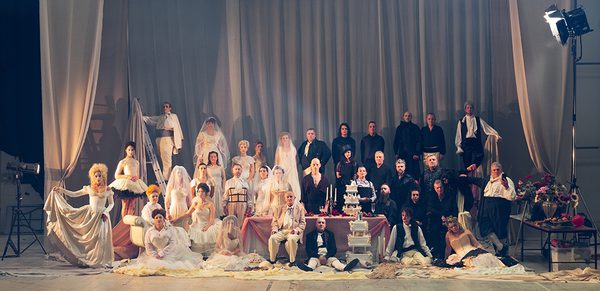
This autumn, WNO brings Oedipus Rex together with Bartók’s Bluebeard’s Castle: two works shaped by ritual, dangerous questions and truths that refuse to remain hidden.
Conducted by Lidiya Yankovskaya and directed by Joe Hill-Gibbins, the double bill will be performed in Cardiff, Llandudno, Southampton, Oxford and Plymouth from 20 September – 28 November 2026.