Who is Hildegard von Bingen?
Benedictine abbess. Polymath. Composer. Visionary. Icon.
Born in 1098 in Bermersheim in the Rhineland, Hildegard von Bingen lived within the emphatically male world of the medieval Church. Yet she became one of its most remarkable and influential voices.
A composer, poet, theologian, preacher, natural philosopher and visionary, Hildegard founded two monasteries, corresponded with popes, bishops and Emperor Frederick Barbarossa, challenged powerful clergy and preached publicly at a time when women were rarely permitted such authority.
Visions
Hildegard’s life was shaped by visions.
She said that she had experienced them since childhood. Later in life, she described perceiving them within what she called the Shadow of the Living Light (umbra viventis lucis), an experience that remained central to her spiritual and creative life.
For many years, she was hesitant to speak openly about what she saw. She confided in Jutta of Sponheim, a religious recluse and her early mentor, who became an important figure in Hildegard’s religious life.
In 1141, during the forty-third year of her life, Hildegard experienced the vision that would change its course. She described hearing a divine command:
“Say and write what you see and hear.”
She began recording her visions, eventually producing Scivias - meaning “Know the Ways” - her first major theological work. In it, she documented and interpreted her visions alongside her own fear, uncertainty and struggle over making them public.
Those experiences would continue to inform an extraordinary body of theology, poetry, imagery and music.
The Natural World
Hildegard also wrote extensively about plants, animals, the human body, medicine and the natural world.
In Physica, she catalogued the properties and perceived medicinal uses of hundreds of plants, trees, animals, minerals and other natural substances, drawing on medieval learned traditions and practical knowledge available within monastic life.
A recurring idea throughout her writing was viriditas - often translated as “greenness”. The concept connects the vitality and fertility of the living world with physical health, spiritual flourishing and divine creation.
Her interests even extended to language. She devised the Lingua Ignota, or “unknown language”, which survives principally as a glossary of 1,011 invented words accompanied by its own alphabet.
Music
Music was central to Hildegard’s understanding of the divine.
She composed 77 surviving liturgical chants, most intended primarily for performance within her religious community, although some appear to have been written for other audiences.
Her melodies move across an unusually expansive vocal range. They rise, fall and spiral through the voice, sometimes stretching a single syllable into a long, ecstatic phrase.
For Hildegard and the women of her communities, singing was an essential part of worship: a shared musical language through which they could express faith, devotion and the spiritual world that shaped their lives.
Her collection Symphonia armonie celestium revelationum - the Symphony of the Harmony of Celestial Revelations - brings together these sacred songs, connecting monastic worship with the celestial harmony Hildegard perceived through her visions.
Among them is O rubor sanguinis, an antiphon probably composed for First Vespers for St Ursula and her companions, the Virgin-Martyrs of Cologne. Without naming Ursula directly, it transforms the red of martyrdom into an image of flowering, virginity and spiritual endurance.
Another, Rex noster promptus est, is a responsory for the Feast of the Holy Innocents, commemorating the children killed on the orders of King Herod.
Nearly 900 years later, Hildegard’s music still has the power to fill a space.
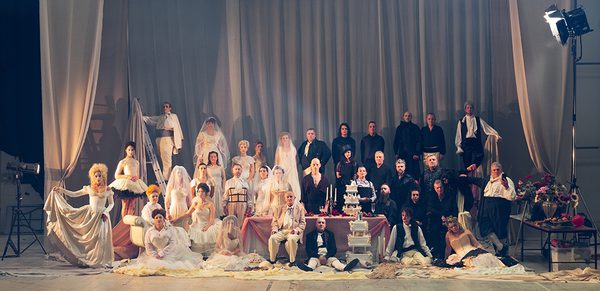
Hear O rubor sanguinis and Rex noster promptus est, performed by the women of WNO Chorus, in Bluebeard’s Castle + Oedipus Rex, opening at Wales Millennium Centre on 20 September 2026 before touring to Llandudno, Southampton, Oxford and Plymouth.